Complete visibility into your
organization's cryptography.
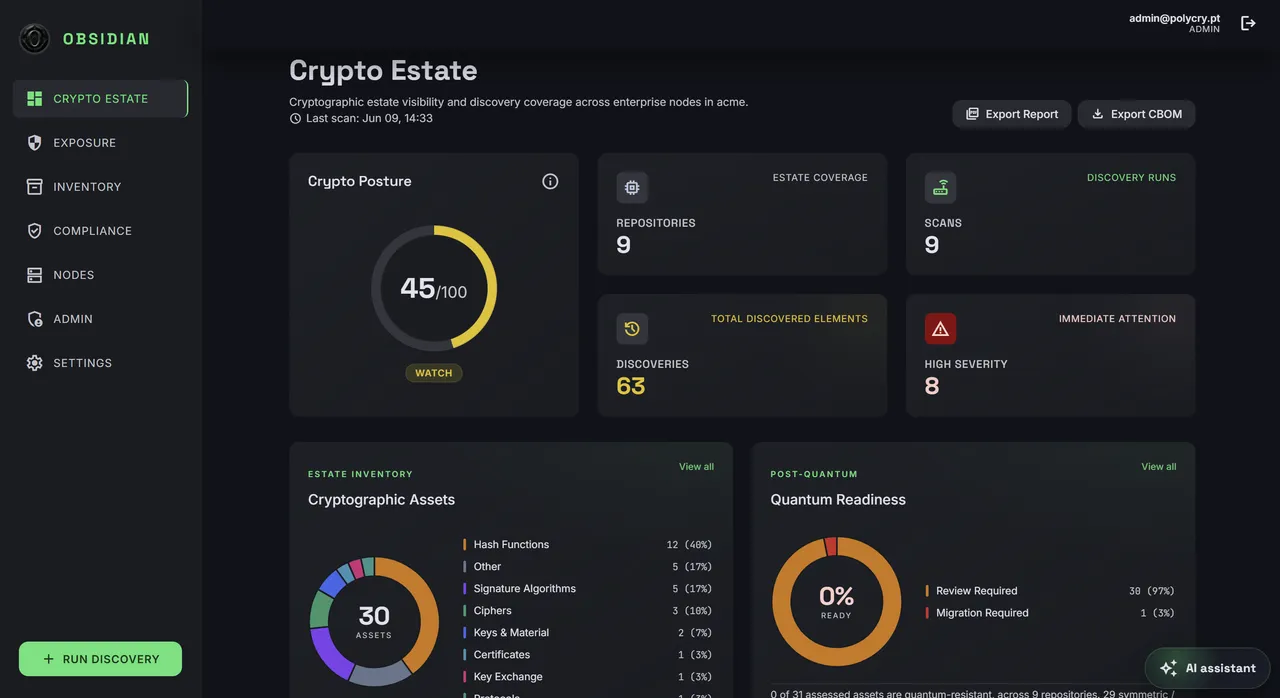
Obsidian discovers cryptographic assets across your repositories, scores migration risk for the post-quantum transition, and hands discoveries to developers and AI agents.
Four jobs. One instrument.
From the first scan to the last migration ticket. Obsidian operates across the lifecycle of a cryptographic asset.
Find every cipher in your code.
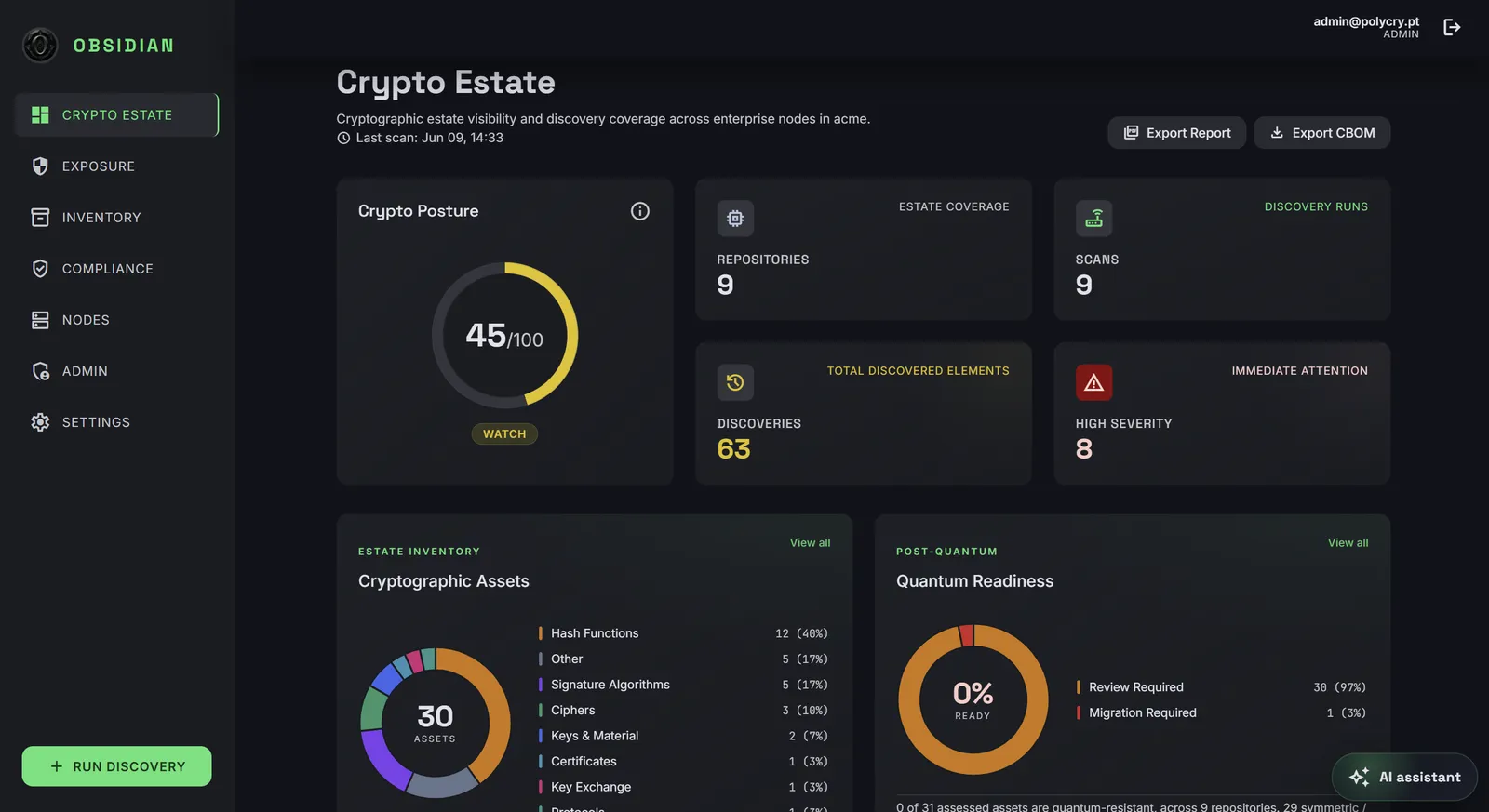
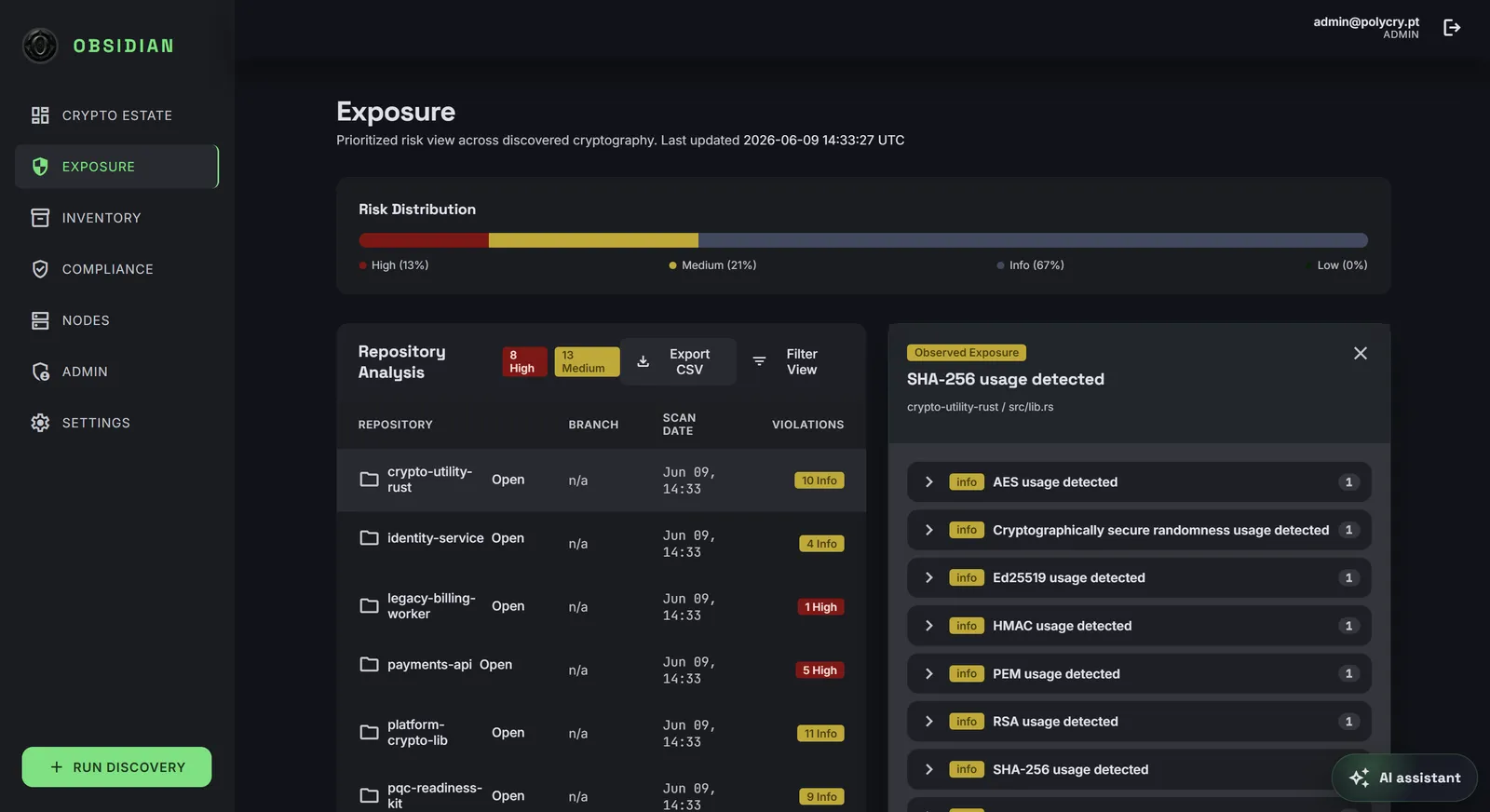
Native AST analysis for Go, Python, JS/TS, Rust, Java, C#, Shell, C and C++, purpose-built for cryptography. Detects algorithm usage, key sizes, library calls, KMS/HSM and custody references, and more with file/line evidence for every finding.
Score what to migrate first.
Readiness bands per repo, driver/blocker analysis, and recommended next steps so engineering leadership can sequence the migration with evidence.
Generate audit-ready proof.
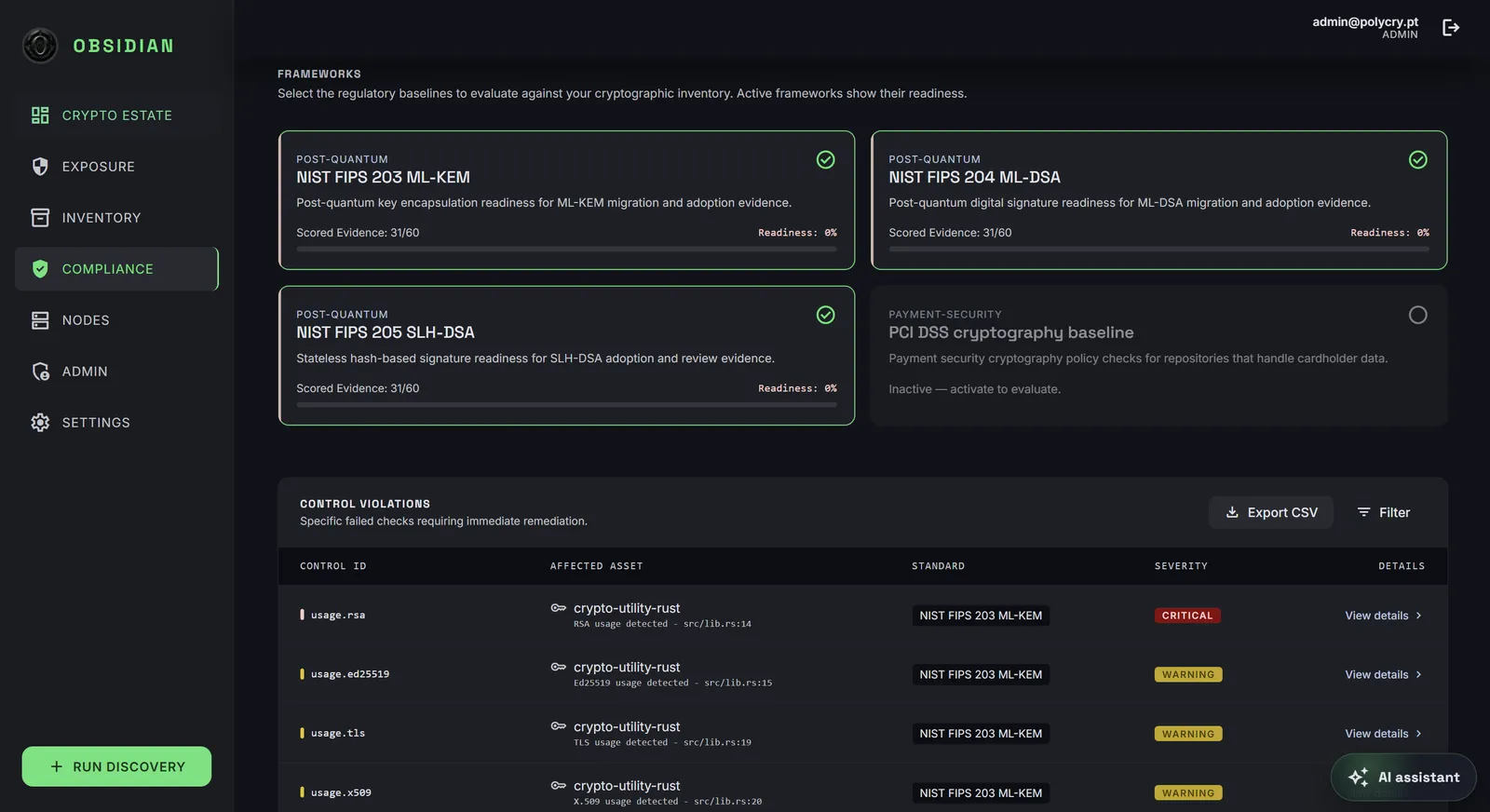
PQC posture reports, CycloneDX CBOM exports, control violation views, and audit snapshots mapped to the frameworks your auditors actually ask about.
Hand it to developers — or agents.
One-click GitHub issue handoff with full evidence. Plus an MCP server for Claude, Cursor, and any coding agent so AI can act on discoveries with the context it needs.
A console for your cryptography.
No box-and-line dashboard. Tonal layering, dense data, no chrome. Built for the analyst who needs to read a hash, not click a wizard.
Scan. Inventory. Migrate.
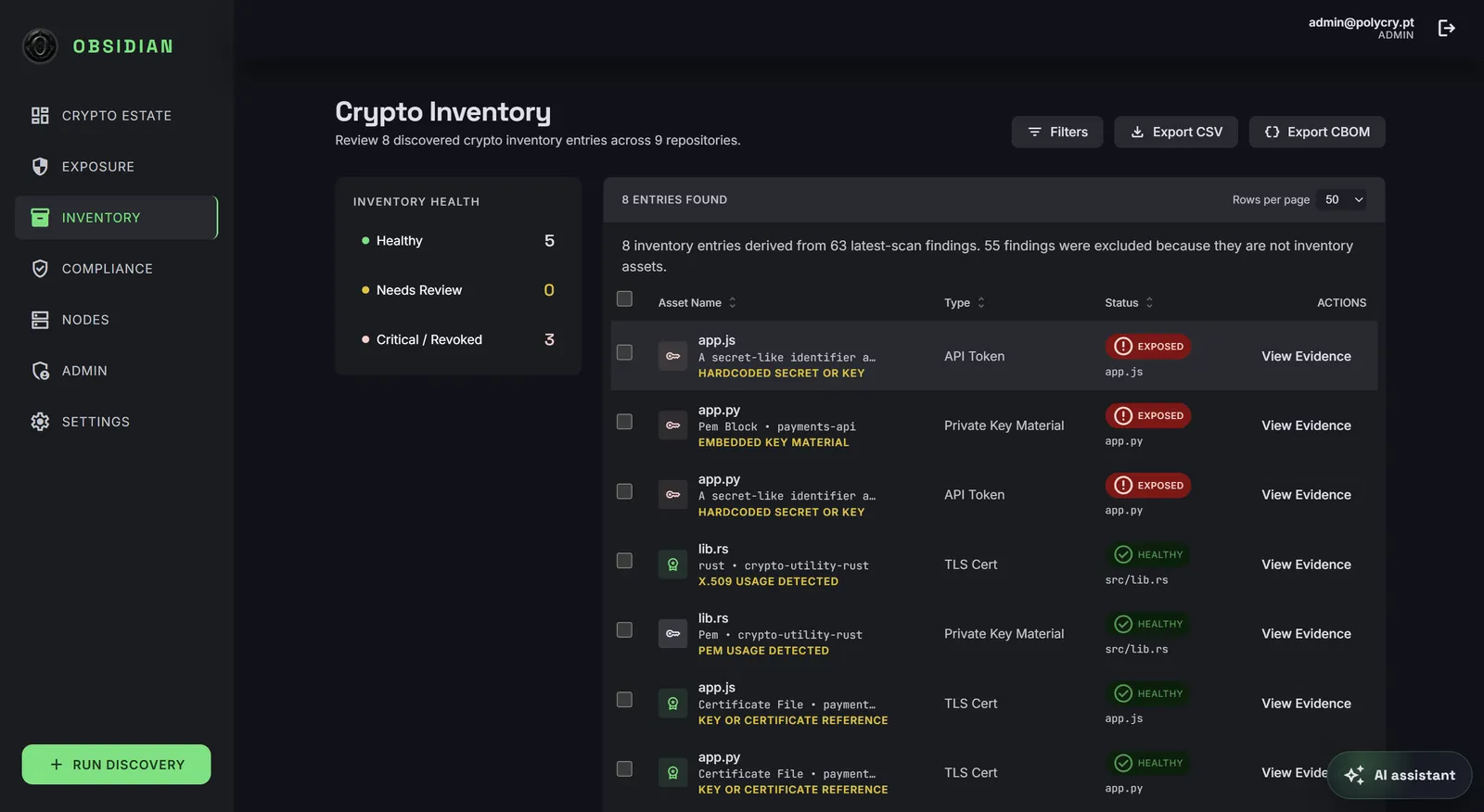
A scanner runs in your environment. Discoveries normalize to one model. Everything else like reports, tickets and agent context derives from that single inventory.
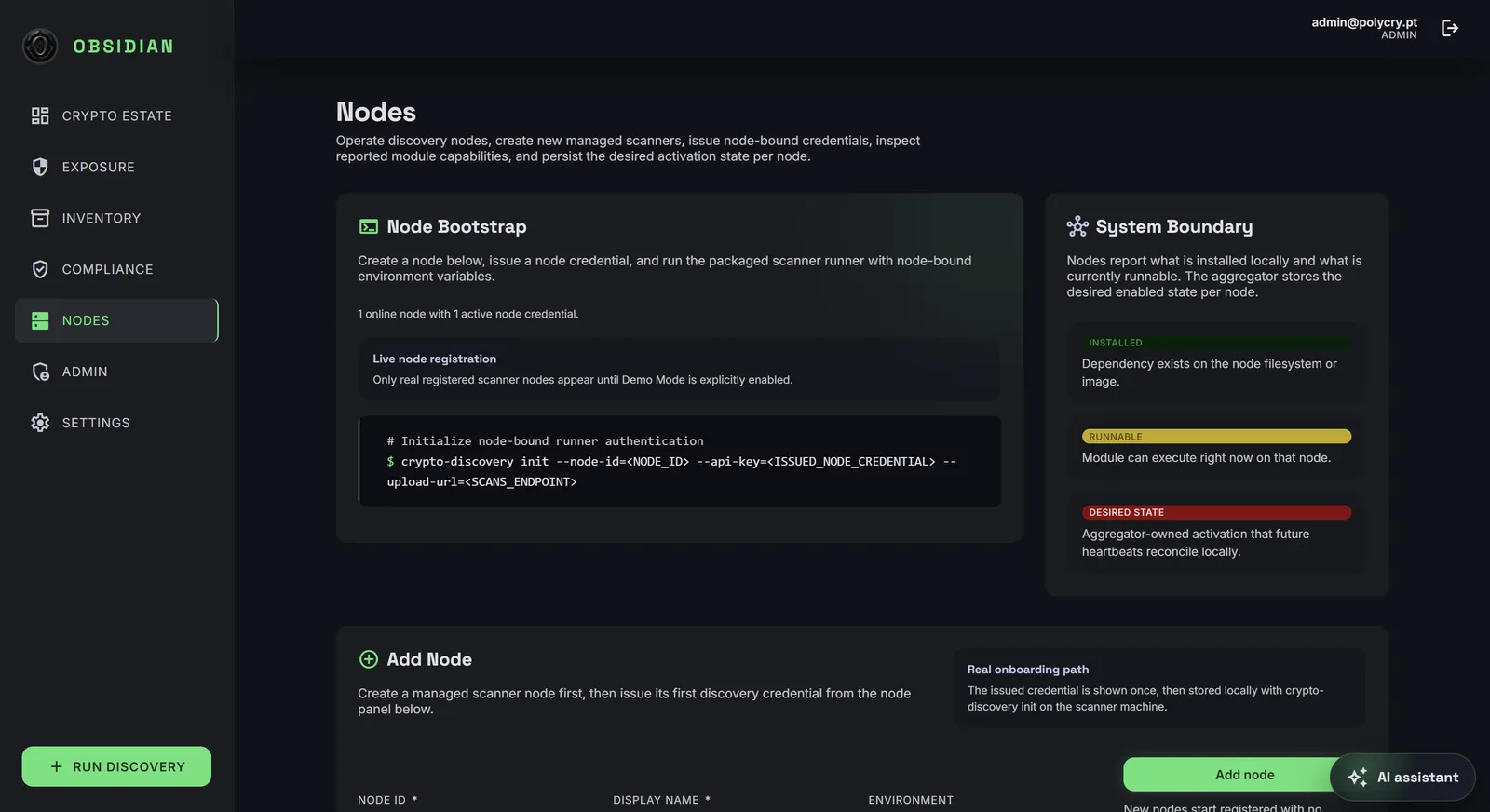
Run anywhere, register a node.
CLI for local repos. Long-running scanner nodes with bound credentials for automation. Job-scoped clone tokens so scanners never see more than they need.
One model for every detector.
Whatever found it like Semgrep, a custom rule or a PQC signal normalizes to the same discovery: algorithm, library, API, key size, file/line evidence, rule ID, severity, confidence, recommendation. New detectors plug in; the model stays stable.
Tickets, reports, or agent calls.
Open a GitHub issue with full evidence. Export a CBOM for procurement. Or let an AI agent fetch context through the MCP server and propose a patch.
Built for the coding agent you'll deploy next quarter.
Obsidian exposes its knowledge like repo posture, discoveries, migration candidates, developer context and compliance status through a read-only AI assistant and an MCP server.
- AssistantUse the built-in AI assistant to get more information on findings.
- MCPRemote MCP over Streamable HTTP, bearer-auth'd and org-scoped ready for your agent of choice.
- SOURCEDThe AI never does the discovery. Scanning is deterministic static analysis. The assistant only reads and cites the scan, finding, or document each answer came from. No hallucinated CVEs.
- ECDSA-P256 in
auth/jwt.go— 8 occurrences blocking signature migration to ML-DSA. - RSA-2048 handshake in
tls/handshake.go— needs hybrid KEM via cloudflare/circl. - DH-2048 key exchange in
vpn/tunnel.go— classical KEX exposed to harvest-now-decrypt-later.
Audit-ready by default.
CBOM, posture reports, policy framework support, control violations, and audit snapshots. Tracked against the standards your auditors already use.
Connects to your sources. Surfaces crypto everywhere it lives.
Seamlessly integrate GitHub Apps, PATs or public repos and run scans across your inventories discovering cryptographic assets wherever they appear, including the KMS, HSM, and custody platforms your code references.
/api/v1 JSON for summaries, findings, CBOM, and compliance reports.runtime/certificates module inspects TLS endpoints and certificate material.2030 isn't far. Most codebases aren't ready.
NIST has finalized the algorithms. DORA already requires EU firms to manage their cryptographic controls. The work is finding every place your code touches a cipher and that's the work no team has time for.
Priced per repository, not per finding.
Discoveries should never be a metered cost. You should be free to find more.
- 1 repository · unlimited scans
- CLI scanner, local-only
- Inventory + crypto posture score
- CBOM export
- Community Discord
- Everything in Starter
- Scanner nodes & scheduled scans
- GitHub App + issue handoff
- AI assistant + remote MCP
- Compliance reports & audit log
- Email + Slack support
- Everything in Team
- Self-hosted control plane
- HSM-backed secret store
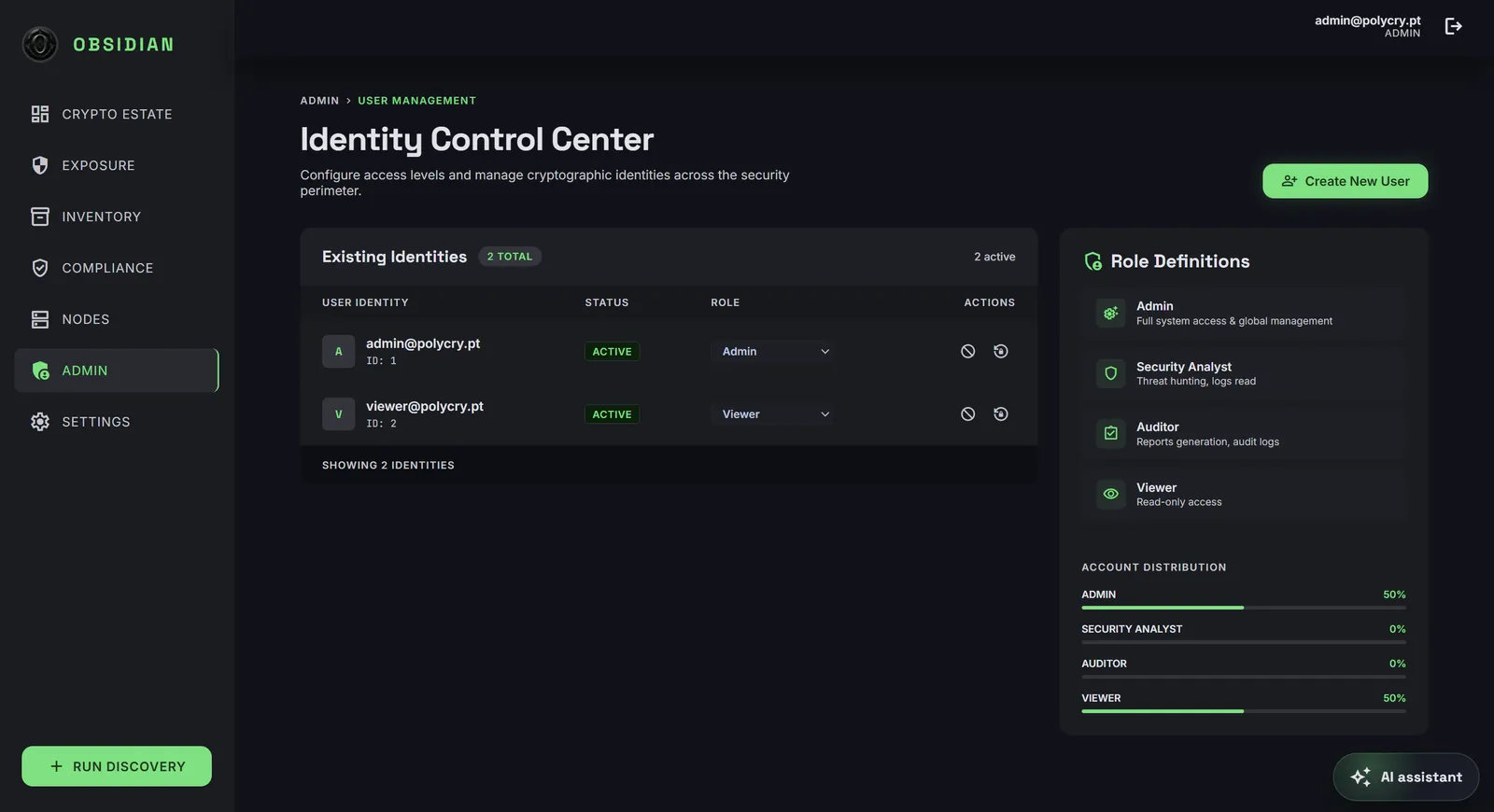
- SAML SSO + RBAC
- Custom policy frameworks
- Dedicated engineer
See your cryptographic posture
in under 8 minutes.
We'll spin up an Obsidian instance against one of your repos, walk through the discoveries, and leave you with a CBOM you can hand to your auditor.